
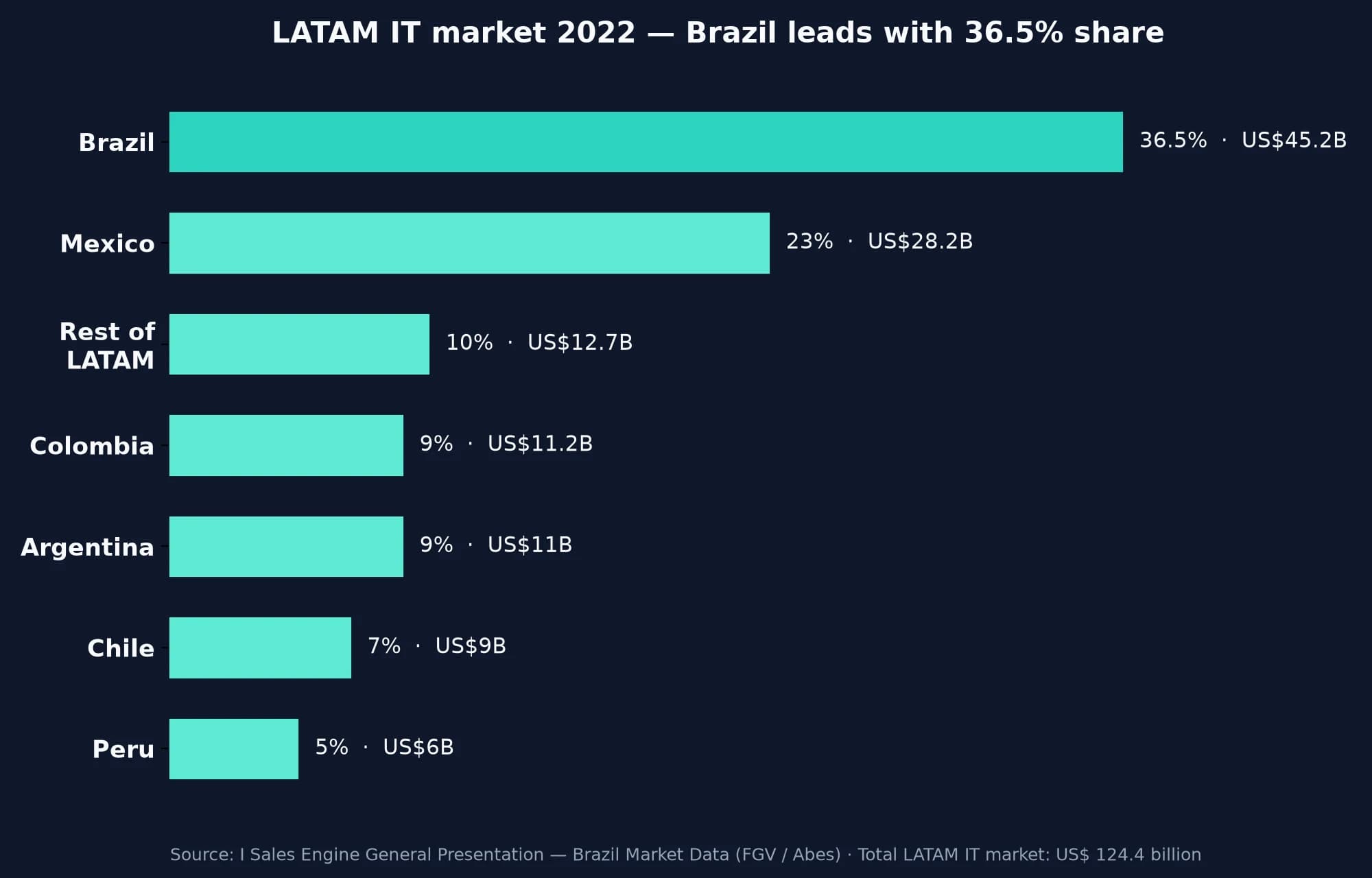
Executive takeaway: Brazil can be a strong entry point for LATAM expansion, but only when the commercial operation is built for local execution, not just for market ambition.
Many vendors see Brazil as a market to enter and a possible base for wider LATAM growth. That logic is sound. Brazil brings size, commercial density, language access, and proximity to regional decisions. But it also brings a practical problem: local execution is not the same as headquarters planning.
If a company enters Brazil with product-market fit from abroad, but without local process clarity, CRM discipline, and ownership structure, expansion becomes costly and difficult to scale. The question is not simply whether Brazil is attractive. The question is whether the company can operationalize growth in a way that survives the first cycle of real market contact.
Why Brazil is often the right first move
Brazil is not just another country in LATAM. It is often the highest-traction market for companies selling B2B solutions, SaaS, services, and operational tools. It offers volume, local complexity, and commercial opportunities that can be used as a platform for regional expansion.
But the opportunity only becomes strategic when the company can localize the commercial layer. That means adapting ICP, value proposition, messaging, sales cadence, qualification logic, and CRM governance to the way buying behavior actually works in the market.
That is where many international businesses get stuck. They assume that what works in a headquarter market will work in Brazil with minimal changes. In practice, local execution requires more than translation.
What needs to be in place before scaling
Before a company uses Brazil as a LATAM base, it usually needs a few things that are easy to overlook:
- clear ownership between headquarters and local sales execution;
- pipeline visibility with defined stages and accountability;
- CRM structure that reflects the real sales process, not a wish list;
- lead routing and follow-up rules that reduce friction and delay;
- local messaging and commercial rhythm tuned to the market.
Without those elements, a company will often reach Brazil with optimism and leave with scattered data, inconsistent follow-up, and weak conversion. Scale only works when the local engine is coherent.
Why CRM and automation matter here
When a company expands through Brazil, the operational problem becomes more visible fast. Leads arrive from multiple channels, the team needs follow-up discipline, and the leadership wants a clearer view of what is truly moving. That is exactly where CRM and automation help.
A strong local process usually includes:
- lead routing by territory, segment or sales owner;
- automated reminders for stalled deals;
- deal stages that map to the actual sales motion;
- clear connection between marketing, sales and support;
- local reporting that helps management decide where to focus next.
This is not just back-office efficiency. It is what makes expansion measurable. Without this layer, the company may be active in Brazil without actually being able to read the market correctly.
That is also why Bitrix24 and CRM implementation are often part of the first real operational step for market entry.
How local commercial execution should be designed
Good expansion design is not only about market analysis. It is about commercial architecture. In practical terms, that means building a local motion that has enough structure to scale without excessive dependence on individual sellers or informal routines.
For many companies, the best approach starts with business context and process, then moves to tool architecture. This can include local positioning, follow-up planning, customer segmentation, outbound structure, and visibility across the pipeline. Once that is clear, automation and CRM become an asset rather than a burden.
When the entry model is working
Brazil is a strong venue for regional expansion when the business can answer three questions with confidence:
- Do we know which customers are truly relevant in this market?
- Do we have a local sales motion that can be followed consistently?
- Do we have enough visibility to decide where to invest next?
If those answers are weak, the company is not really expanding. It is experimenting.
That is where LATAM / Brazil and commercial execution services make the most difference: they add the operational layer that turns ambition into traction.
Conclusion
Brazil can become a powerful base for LATAM expansion, but only when the company treats it as an operating model, not just a market opportunity. That means aligning local strategy, commercial process, CRM, and execution support around the same goal: predictable traction.
For vendors that want to scale regionally without losing control, the right move is usually to build the commercial foundation before multiplying channels or chasing volume. That is what turns market entry into a durable regional engine.
Explore also predictability in sales and AI agents in CRM to understand how execution quality compounds over time.