
Executive takeaway: sales outsourcing in Brazil can be a smart way to enter the market fast, but it only creates sustainable value when the company keeps commercial ownership, CRM discipline, local follow-up, and a fully localized go-to-market narrative under control.
International companies often reach the same question when they look at Brazil: should we build an internal sales team or start with outsourcing? The answer is rarely simple, but the decision matters because it affects speed, control, quality of pipeline, and how confidently the company can scale in the largest IT market in Latin America.
Outsourcing is not automatically the wrong model. It is often the right move when the goal is to test demand, build early traction, or create a local commercial motion without committing too much fixed cost too early. But it becomes a trap when the company loses ownership of the commercial process and ends up buying a pipeline without understanding what is actually converting — or worse, without adapting the offer to the Brazilian market at all.

Why the decision matters
There are a few practical differences you need to weigh before choosing a model:
- speed: outsourcing can start faster; hiring internally usually takes longer;
- cost structure: outsourcing is often more flexible, but more expensive per deal in the long run;
- control: internal teams give more control over messaging, follow-up, and process quality;
- commercial knowledge: a local internal team usually understands the product and market better over time;
- scalability: a good internal motion usually scales with less dependence on a partner.
In other words, the right answer depends less on ideology and more on the stage the company is in, the maturity of the product, and how complex the sales process is.
The real cost of not localizing: why Brazil is not a smaller version of your home market
Before choosing between outsourcing and an internal team, most international companies skip a more fundamental decision: whether their go-to-market has actually been adapted to Brazil, or simply translated into Portuguese. According to Flávio Pagotto, CEO of Sales Engine, this single mistake is responsible for more failed market entries than any staffing decision.
"Not tropicalizing the marketing and sales process of a global solution is the biggest waste of capital for companies trying to enter Brazil. They lose a lot of money, and many of them give up on the market believing their solution simply doesn't fit Brazilian culture. But in reality, there was never an adaptation problem with the market — there was a lack of adaptation of the solution to a market that keeps growing." — Flávio Pagotto, CEO of Sales Engine
That distinction matters even more once you look at the size of the opportunity being left on the table. Brazil is not a secondary LATAM market to be handled with leftover budget — it is the anchor of the region.
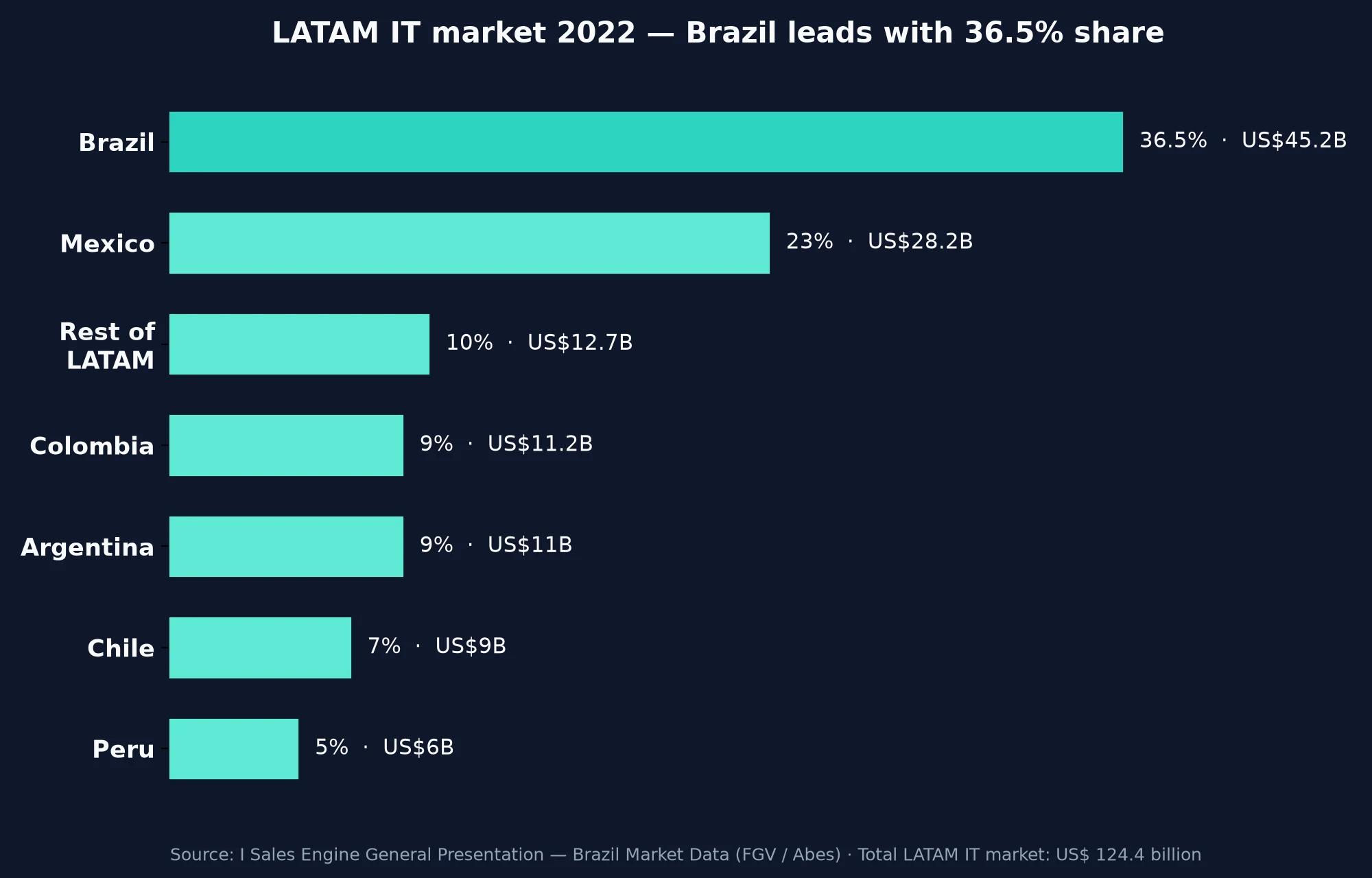
Brazil's digital footprint reinforces the same point: the country counts 2.2 digital devices per capita, totaling 464 million devices in use, with IT spending representing about 9% of company revenue and an average annual IT cost per user of US$52,000 (source: FGV / Abes). A market of this size does not reward companies that show up with an unadapted deck and a translated pitch. It rewards companies that rebuild the commercial narrative, the ICP, and the execution model for local reality — which is exactly what turned the JobCTRL case into one of Sales Engine's strongest examples of market reactivation.
When sales outsourcing works
Outsourcing usually makes sense when the company needs to learn quickly without putting a large fixed structure in place. That scenario is common in early Brazil entries or in market tests where the company is validating sales motion and local relevance.
It tends to work well when:
- the company is validating demand before committing to a larger local team;
- the offer is relatively clear and the sales process is not highly complex;
- there is a need for quick local coverage without long hiring cycles;
- the market is promising but not yet fully validated.
In that case, outsourcing can give the company real operational momentum. It can create early conversations, bring structure to prospecting, and accelerate the first learning loop.
When outsourcing creates risk
Outsourcing begins to create real risk when the company loses commercial clarity. This usually happens when the partner does not deeply understand the product, the ICP is vague, or the company is not actively managing the quality of the pipeline.
The danger is not that the partner "does not work". It is that the company can end up with activity, not sales logic. The partner may generate conversations, but without clear ownership and feedback loops the business does not really learn what is working.
This is especially harmful when the offer is complex, the deal cycle is longer, or the product requires deeper commercial explanation. In those cases, the sales motion needs product knowledge and strong internal process design, not just a prospecting engine.
That is why the decision should never be based only on cost per lead. It should be based on how the company will actually turn conversations into pipeline, conversion, and repeatable growth.
Case: how JobCTRL rebuilt its Brazilian pipeline through local execution
The JobCTRL case is one of the clearest illustrations of what happens when local execution replaces a generic global playbook. JobCTRL, a Hungarian workforce-analytics and productivity software company, already had a proven product in Europe and Asia. In 2014, during the World Cup, its global CEO visited Brazil and saw major potential: a growing economy, millions of connected professionals, and a business culture undergoing digital transformation.
The company opened more than 10 regional offices with local sales and support teams. But without a structured commercial process, without automation, and without a strategy adapted to Brazilian reality, results fell far short of expectations. After three years, the operation lost momentum, and headquarters lost confidence in the market itself — not realizing the real gap was execution, not demand.
In 2021, global leadership gave the Brazilian operation one last challenge: whoever sold more than 30 licenses would receive full investment to develop the market. That is when Sales Engine took over, with a mandate to rebuild the commercial engine from the ground up and prove, with data, that Brazil could become one of the brand's strongest global operations.
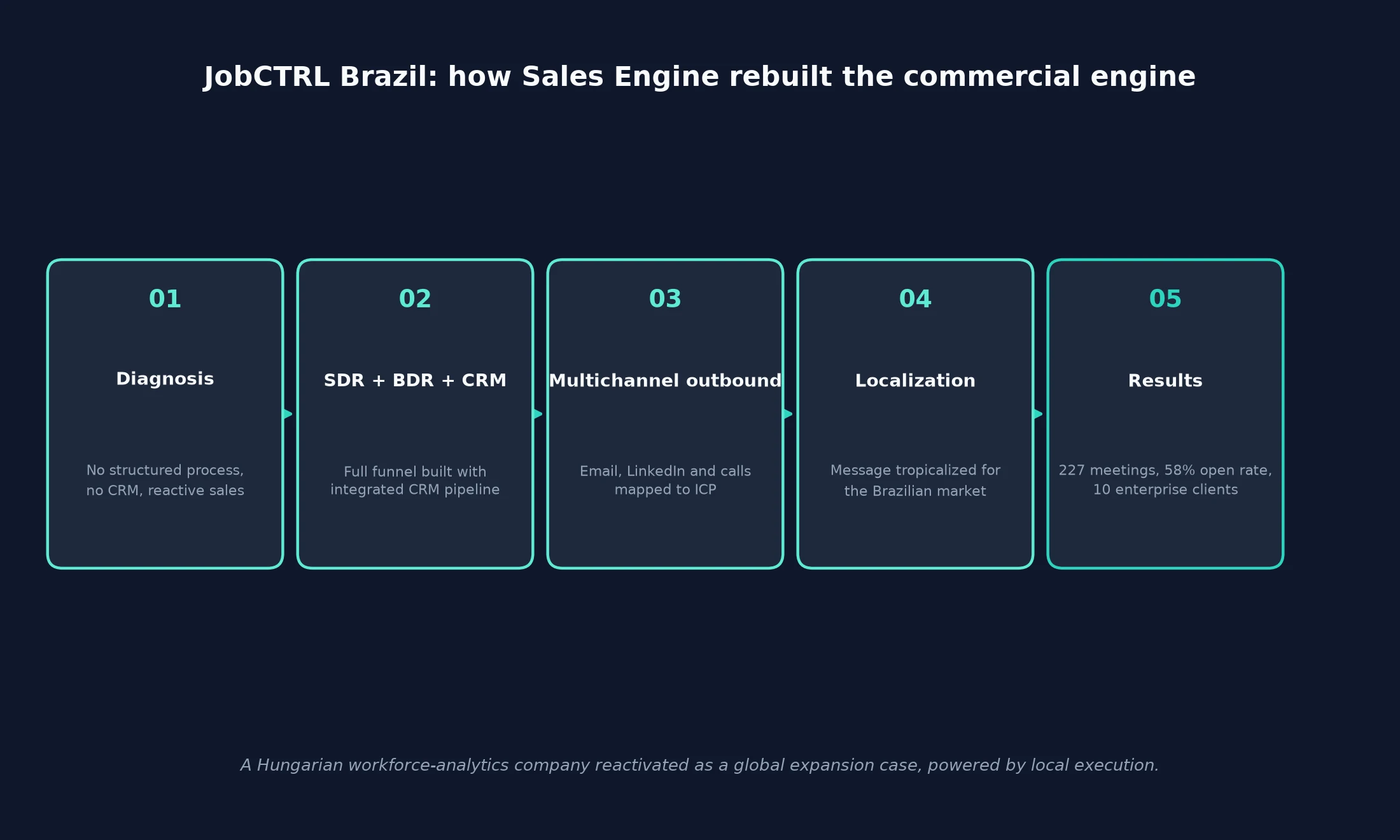
The rebuild rested on four pillars: a full SDR + BDR + CRM funnel with end-to-end pipeline visibility; structured multichannel outbound across email, LinkedIn and calls, targeted at mid-size and large companies with hybrid or remote operations; a value narrative fully tropicalized for the Brazilian post-pandemic context, shifting the pitch from generic productivity metrics to hybrid team management and intelligent performance control; and a continuous execution cadence of more than four meetings per week, with every interaction logged and analyzed inside the CRM.
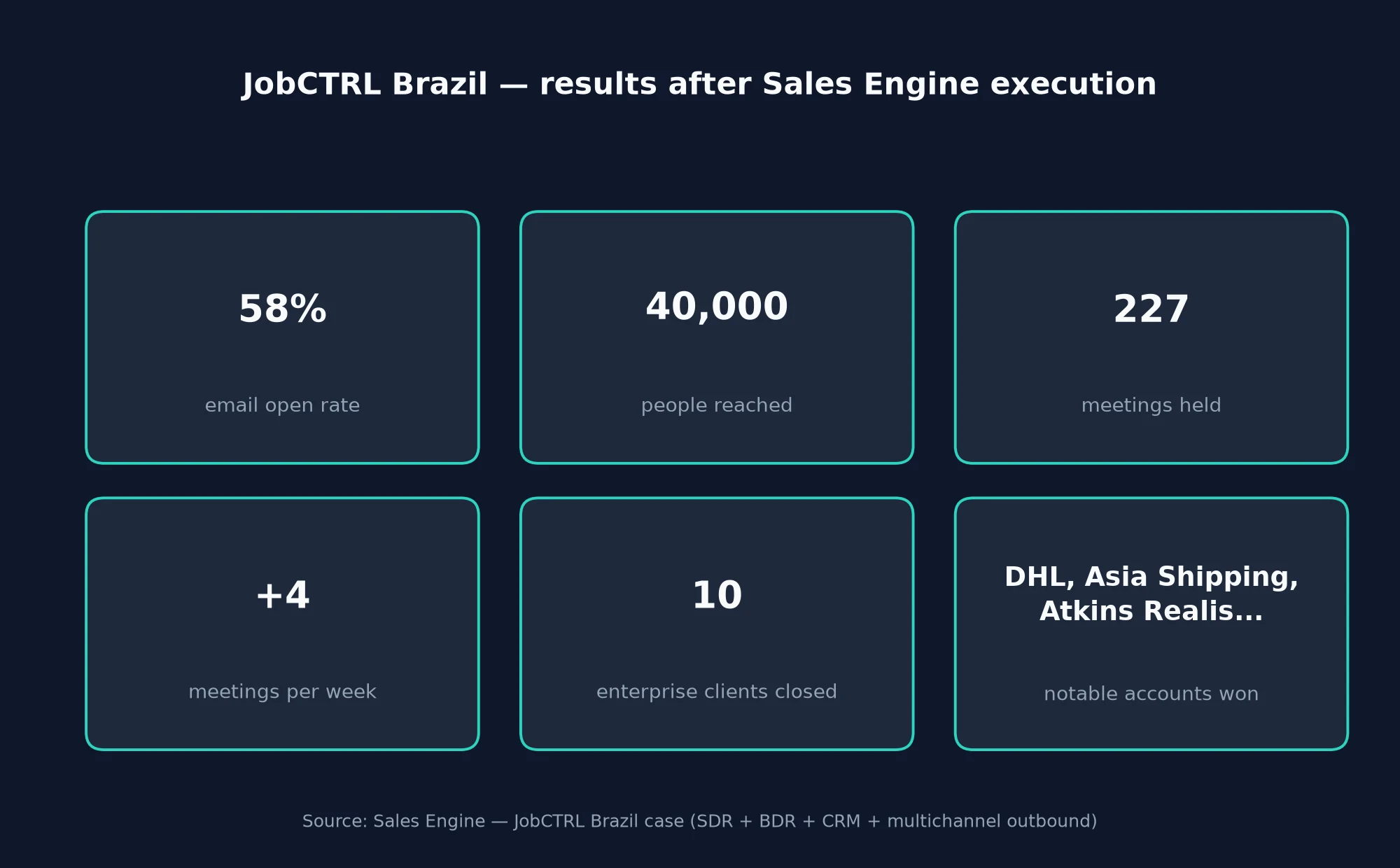
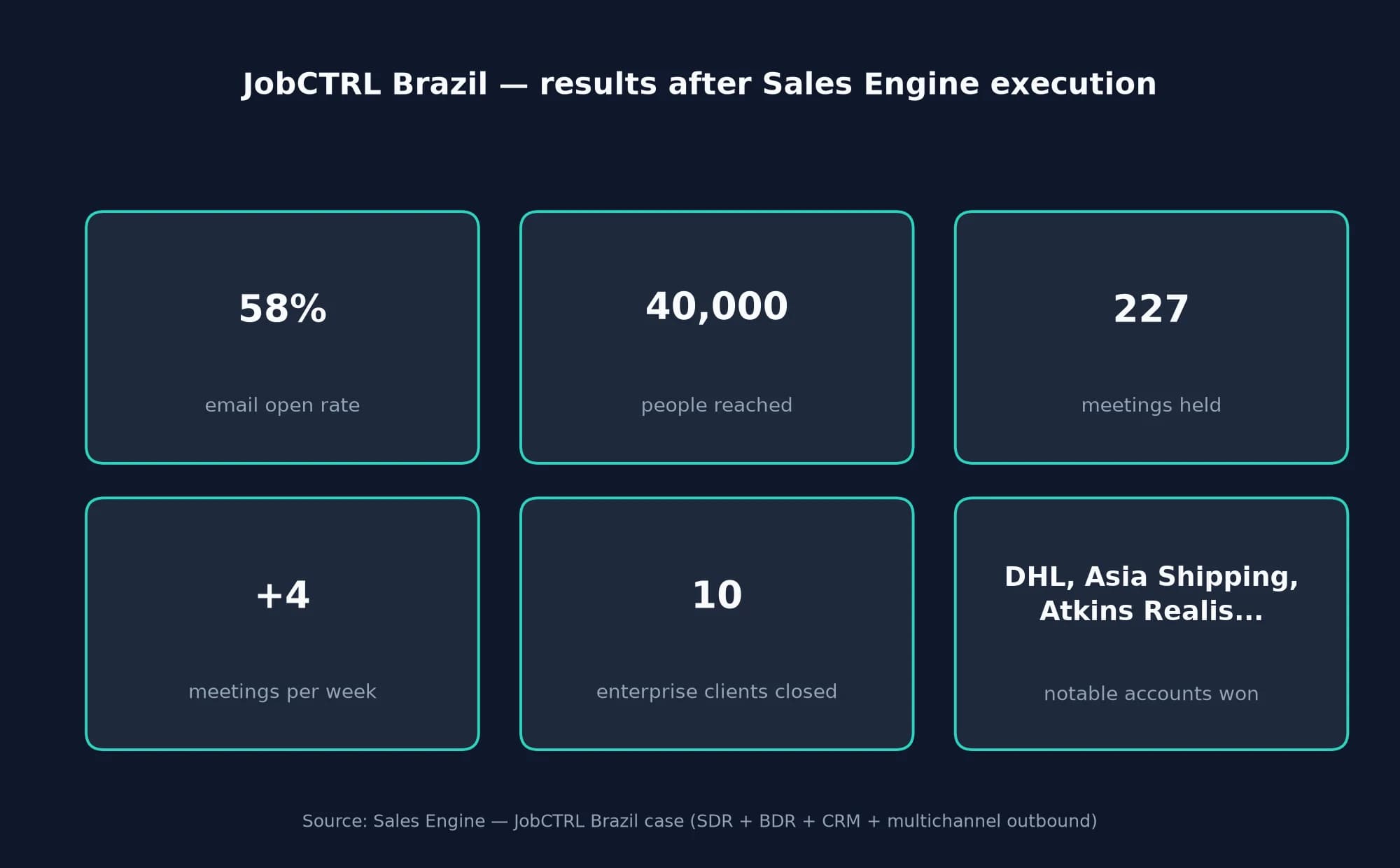
In under a year, the Brazilian operation reached 58% email open rates, 40,000 people reached, 227 meetings held, and 10 new enterprise clients — including DHL, Asia Shipping, Mangels, Atkins Realis, Interfreight and Votorantim. "Sales Engine showed that the Brazilian market has maturity and potential. Today, Brazil is one of our most consistent international expansion cases," said JobCTRL's global CEO. The structure was later replicated in Portugal and Spain, and the lesson about localization became a reference across the JobCTRL group. Read the full JobCTRL case for the complete breakdown.
What a strong internal team gives you
A local internal team is usually stronger when the company already has a clearer ICP, product-market fit, and confidence that the sales motion is repeatable. It gives the business more control over:
- message quality;
- pipeline discipline;
- deal progression and qualification;
- feedback loops for product and positioning;
- commercial culture and long-term process ownership.
Internal teams scale better when the company has the operating muscle to coach, manage, and improve the process. That can be a major advantage, especially when the sales motion is more consultative or requires deeper understanding of the customer context.
A practical hybrid model
For many companies, the most practical route is not pure outsourcing or pure internal hiring. It is a hybrid model: use local outsourced prospecting for speed and volume, while keeping internal ownership of the product story, feedback loop, and deal quality.
That model keeps the company from completely depending on a partner while still avoiding the long delay of building a full team from zero. It also makes it easier to validate the ICP before deciding whether permanent local hiring makes economic sense.
In this structure, the internal team can focus on higher-quality follow-up, commercial alignment, and conversion, while the outsourced layer accelerates the top of the funnel.
How to make the decision
Before choosing a model, the company should answer a few practical questions:
- Is the product already clear enough to explain well in the local market?
- Is the sales cycle short and repeatable, or highly consultative?
- Do we need deep learning from the market before scaling?
- Is our main problem demand generation, conversion quality, or both?
- Has our go-to-market actually been localized, or only translated?
- Do we want faster entry or stronger long-term control?
If the company is still validating the basic motion, outsourced prospecting can be smart. If the company already knows the target segment, has a clearer offer, and wants to build a durable local engine, internal execution becomes more compelling. Either way, the JobCTRL case shows that the model matters less than the discipline behind it: CRM visibility, localized narrative, and continuous execution.
That logic aligns directly with Brazil market entry, CRM structure, and long-term commercial execution planning.
Conclusion
Sales outsourcing in Brazil can create value when it helps the company test the market and build momentum without overcommitting before the sales motion is proven. It is not a universal answer, but it is often a useful early move — as long as it comes with a localized offer, not a translated one.
The mistake is treating outsourced sales as a substitute for operational ownership, or treating Brazil as a market that simply needs more effort rather than a different playbook. The company still needs process control, CRM visibility, and a message adapted to local reality. Without that, the business buys motion without building the engine behind it — and, as the JobCTRL case shows, walks away from one of the largest IT markets in the world for the wrong reason.
For companies entering Brazil with intent, the better question is not "internal or outsourced?" It is "which model gives us the clearest route to a repeatable, accountable, and truly local sales engine?"